

France Detains Over 400 as High School Protests Intensify Nationwide
French authorities detained more than 400 people on Tuesday, the vast majority of them minors, as student demonstrations at high schools rippled across the country and grew increas
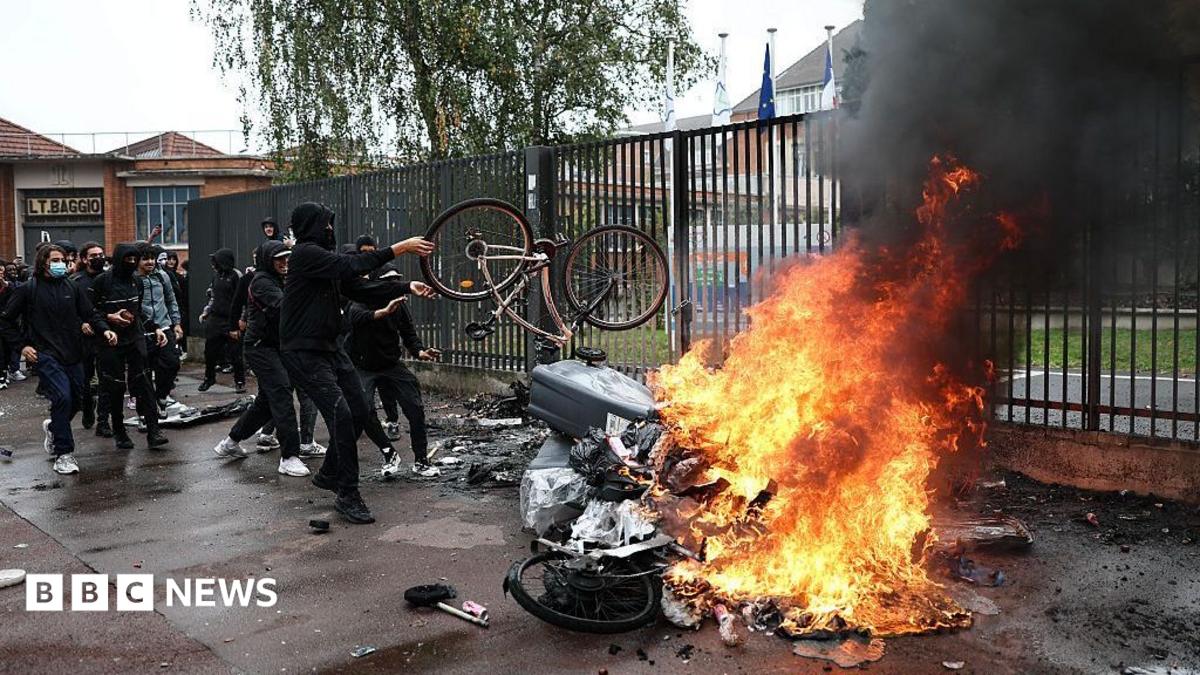
French authorities detained more than 400 people on Tuesday, the vast majority of them minors, as student demonstrations at high schools rippled across the country and grew increasingly confrontational, Interior Minister Laurent Nuñez confirmed. Speaking to the broadcaster BFMTV, Nuñez said the figure was still provisional and that roughly two-thirds of those taken into custody had been placed under formal police detention. The scale of the detentions marks a sharp escalation in a protest movement that only days earlier had centred on school blockades in and around Paris.
At the heart of the unrest is a deep frustration among French teenagers over conditions in the country's secondary schools. Students point to chronically overcrowded classrooms and a shortage of teachers as the central grievances driving their actions. According to the education ministry, at least 400 schools were affected by the disruptions on Tuesday, a figure that underscores how widely the movement has spread beyond the capital region where it first took hold.
The protests have not been peaceful in every instance. Officials reported that at least ten teachers and several students were hurt during Tuesday's demonstrations, along with 48 members of the law enforcement services. Photographs and video footage circulating online appeared to show rubbish bins set alight and bus stops vandalised by participants, imagery that has fuelled a heated debate in France about the character of the movement.
One 16-year-old female student, speaking to the AFP news agency, rejected the suggestion that protesters were bent on destruction. "We're here to deliver a message," she said. "We're not here to smash everything up for no reason. We're here precisely to say that the education system is completely broken. There are 34 of us in each class, and it's just not feasible. The teachers are overworked." Her account captures the mixture of grievance and defiance that has come to define the demonstrations.
The government's response has been split between acknowledging the right to protest and condemning outbreaks of violence. Education Minister Édouard Geffray, writing on the social media platform X, said students were entitled to demonstrate but described reports of violence as "indefensible." In a later post on Tuesday evening, he sharpened his language, arguing that "the right to demonstrate is a fundamental freedom that cannot serve as an excuse for such actions." He added that legitimising such behaviour, or calling for blockades to be extended, would put students and public employees at risk, calling it "irresponsible."
Interior Minister Nuñez faced pointed questions about the policing of the protests, which has drawn criticism from several French politicians. He defended the security response as having been "carried out in an extremely proportionate manner," even as French media reported that demonstrators had thrown projectiles at officers, who replied with batons and tear gas. The competing accounts illustrate how contested the narrative of the day's events has become.
Student representatives have pushed back hard against the government's framing. Ryad Rani, president of the Union Syndicale Lycéenne, told AFP that the state was engaging in "repression" and accused police of using excessive force. His organisation, which speaks for high school students, has become a prominent voice in a movement that has no single leader and has spread largely through social media and word of mouth among teenagers.
The current wave of protest began last week in the Île-de-France region surrounding Paris, where lycée students — the equivalent of sixth-formers in the United Kingdom or high school students in the United States — started blockading their schools. By Monday, the authorities had already detained 164 people, and Prime Minister Sébastien Lecornu issued a public warning that any further escalation would be "irresponsible." In a post on X, Lecornu cited reported incidents including fireworks and fires near high schools, writing that "nothing justifies endangering students, staff, or police officers."
Tuesday's student actions coincided with a broader day of industrial action across France. Unions representing teachers, hospital staff and civil servants staged nationwide walkouts to protest low wages and difficult working conditions. Nuñez said those union-led demonstrations, which drew at least 200,000 participants, largely passed off without incident — a contrast that has led some observers to question why the school protests in particular have turned so volatile.
The timing places additional pressure on a government already navigating tense relations with public-sector workers. When teachers, nurses and civil servants take to the streets on the same day that teenagers blockade their schools, the message from multiple corners of French society converges on a single theme: dissatisfaction with the funding and staffing of public services. For the students, the classroom is the frontline; for the unions, it is the workplace.
The coming days will test whether the government's mix of firm policing and rhetorical condemnation can dampen the movement or whether it will instead deepen the sense of grievance among young protesters. With hundreds of schools disrupted and a significant number of minors now drawn into the criminal justice process, the stakes for both the students and the authorities are considerable. The education ministry has yet to indicate how it intends to address the underlying complaints about class sizes and teacher shortages that protesters say sparked the unrest in the first place.
What's Your Reaction?
 Like
0
 Dislike
0
 Love
0
 Funny
0
 Wow
0
 Sad
0
 Angry
0

Editor Investigasi. Pemenang penghargaan jurnalisme investigasi. Spesialisasi: korupsi, kolusi, dan maladministrasi.






Comments (0)