

Turkish Court Convicts Comedian Deniz Göktaş of Insulting Erdoğan, Orders Release After Nearly 90 Days in Custody
An Istanbul court on Monday found popular stand-up comedian Deniz Göktaş guilty of insulting Turkish President Recep Tayyip Erdoğan, sentencing him to nearly 19 months in prison be
An Istanbul court on Monday found popular stand-up comedian Deniz Göktaş guilty of insulting Turkish President Recep Tayyip Erdoğan, sentencing him to nearly 19 months in prison before ordering his immediate release because of time already served behind bars. The ruling, which also imposes a travel ban that prevents him from leaving Turkey, represents an interim outcome rather than a final resolution. Under Turkish judicial procedure, the court of appeals must still issue the definitive verdict in the case, leaving the comedian's legal future formally unresolved even as he walks free.
The conviction stems from material in a stand-up routine that spread widely online, amassing more than 15 million views on YouTube and turning Göktaş into one of the most recognizable comedic voices in the country. Prosecutors focused their case on a single line in which the performer described the Turkish leader as a "shy dictator." Göktaş has consistently rejected the notion that the remark constituted a criminal act, arguing during proceedings that the term functions as political commentary rather than personal invective. "Dictator is not an insult," he maintained. "It is a political characterisation."
That defense did not persuade the trial court, which convicted him and handed down a sentence of almost 19 months. Prosecutors had originally sought a far harsher punishment, asking the court to impose a prison term of up to 12 years, a demand that underscores the severity with which Turkish authorities can treat speech directed at the head of state. The eventual sentence was dramatically shorter than what the state requested, and because Göktaş had already served 88 days in solitary confinement, the court determined that he had effectively satisfied the penalty and ordered his release.
The comedian's arrest in July was itself a dramatic episode. He was detained and handcuffed at Istanbul airport as he returned from a holiday, a moment that drew widespread attention and turned his case into a rallying point for critics of the government's treatment of dissent. He has spent roughly three months in detention, most of it in isolation, a circumstance that supporters say reflects the pressure placed on those who challenge official power in Turkey.
Even in custody, Göktaş displayed the comedic instincts that made him famous. Speaking from the stand during Monday's hearing, he joked about the toll of his imprisonment. "Three months have been taken away from my life," he told the court. "But I quit smoking, so I'll add another three months to my life." The remark prompted laughter and loud applause inside the courtroom, a rare moment of levity in a proceeding that carried serious consequences.
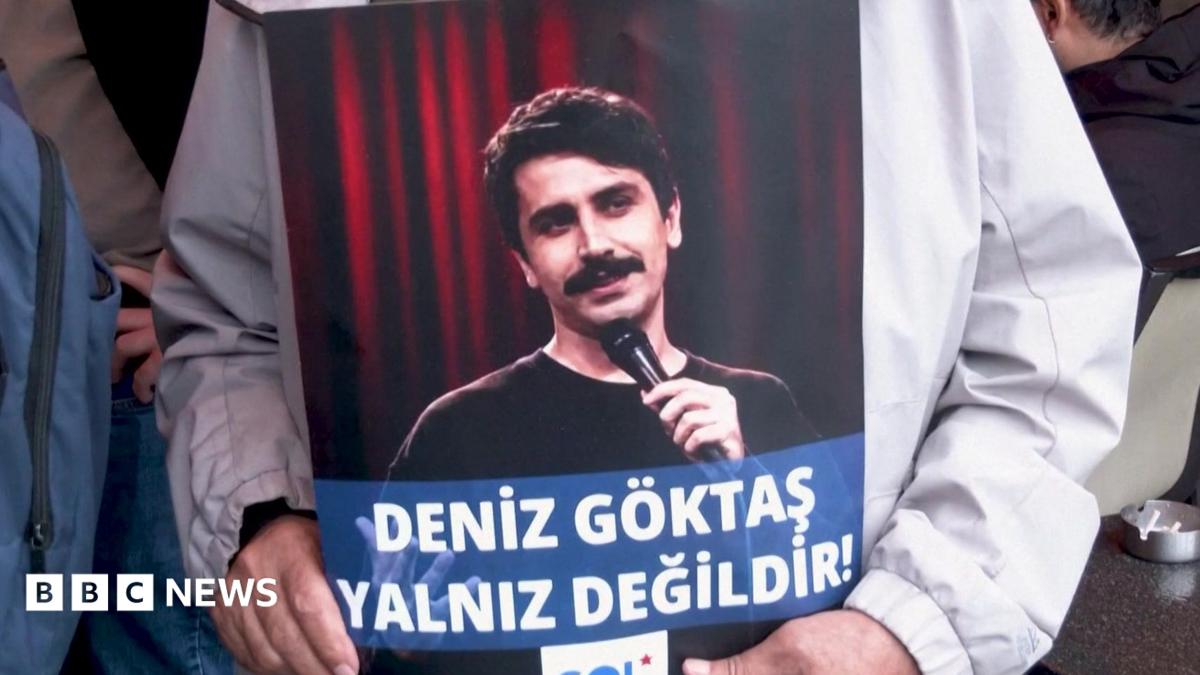
Outside the courthouse in Istanbul, supporters gathered with signs bearing a message of solidarity, translating roughly to "Deniz Göktaş is not alone." Among those celebrating was Firat Aksal, a fellow comedian who expressed astonishment at the outcome. "We hardly know what to do with our happiness," he said. "We are thrilled. To be honest, we weren't hopeful of getting a fair trial." Aksal indicated that Göktaş planned to rest for several days and spend time with his family before returning to the stage.
The verdict nevertheless arrives against a broader backdrop that human rights organizations describe as an intensifying crackdown on political expression in Turkey. Advocacy groups argue that arrests of this kind are designed to suppress dissent and intimidate those who might otherwise speak critically about the government. The case has become emblematic of those concerns, with the comedian's viral routine and subsequent prosecution highlighting the tension between Turkey's vibrant comedic culture and the legal risks that accompany satire aimed at the country's leadership.
The scale of detentions extends well beyond a single entertainer. According to the source account, Turkish prisons currently hold a wide array of individuals whose cases have drawn international scrutiny, including journalists, human rights campaigners, student protesters, LGBTQ activists, and Ekrem Imamoglu, the elected mayor of Istanbul. The incarceration of Imamoglu, a prominent opposition figure, has been particularly controversial, and the cumulative picture suggests a penal system under significant strain as politically sensitive cases multiply.
Göktaş's release is expected within hours, but the travel ban means he remains tethered to Turkey while appellate judges review the conviction. That restriction could complicate any international appearances or tours, and it signals that authorities are not prepared to fully relinquish control over his movements. The appeal process also leaves open the possibility that the sentence could be upheld, reduced, or overturned, keeping a measure of legal uncertainty over the comedian's career.
For supporters, Monday's decision offered a mixture of relief and caution. The release was welcomed as a victory, yet the conviction itself and the pending appeal mean the underlying legal question about the boundaries of political speech in Turkey remains unanswered. The case has resonated internationally, drawing attention to how Turkish courts handle prosecutions involving insults to the president, a charge that critics say is applied broadly and used to penalize legitimate criticism.
Göktaş's own framing of the dispute centers on the distinction between insult and political analysis. By characterizing the president as a "shy dictator" and insisting the phrase was a political description rather than a slur, he has positioned his comedy within a tradition of satire that tests the limits of acceptable discourse. The court's rejection of that argument, even while releasing him on time served, leaves the legal status of such commentary ambiguous and likely to be tested again.
The comedian's plans to resume performing suggest that his public role will continue, and fellow comedians have signaled their support. Whether his return to the stage will be met with official tolerance or further legal action is unclear, particularly given the travel ban and the unresolved appeal. The case has already elevated his profile, transforming a viral routine into a cause that links comedy, free expression, and the broader struggle over civil liberties in Turkey.
Ultimately, the Istanbul court's decision produced a paradoxical result: a conviction and a nearly 19-month sentence, paired with immediate freedom due to time already served. For Göktaş, the immediate prospect is reunification with family and a return to the work that made him known. For Turkey, the episode adds another chapter to an ongoing debate over the price of dissent, the treatment of public figures who criticize the president, and the capacity of the courts to balance state authority with protected expression.
What's Your Reaction?
 Like
0
 Dislike
0
 Love
0
 Funny
0
 Wow
0
 Sad
0
 Angry
0

Editor Investigasi. Pemenang penghargaan jurnalisme investigasi. Spesialisasi: korupsi, kolusi, dan maladministrasi.




Comments (0)