

Taiz on the Brink as Houthi Advance Shatters Truce and Threatens Key Shipping Lane
On a rugged hillside southwest of Taiz, the war in Yemen suddenly became immediate and personal. A government escort scanning the sky warned journalists travelling with him that an
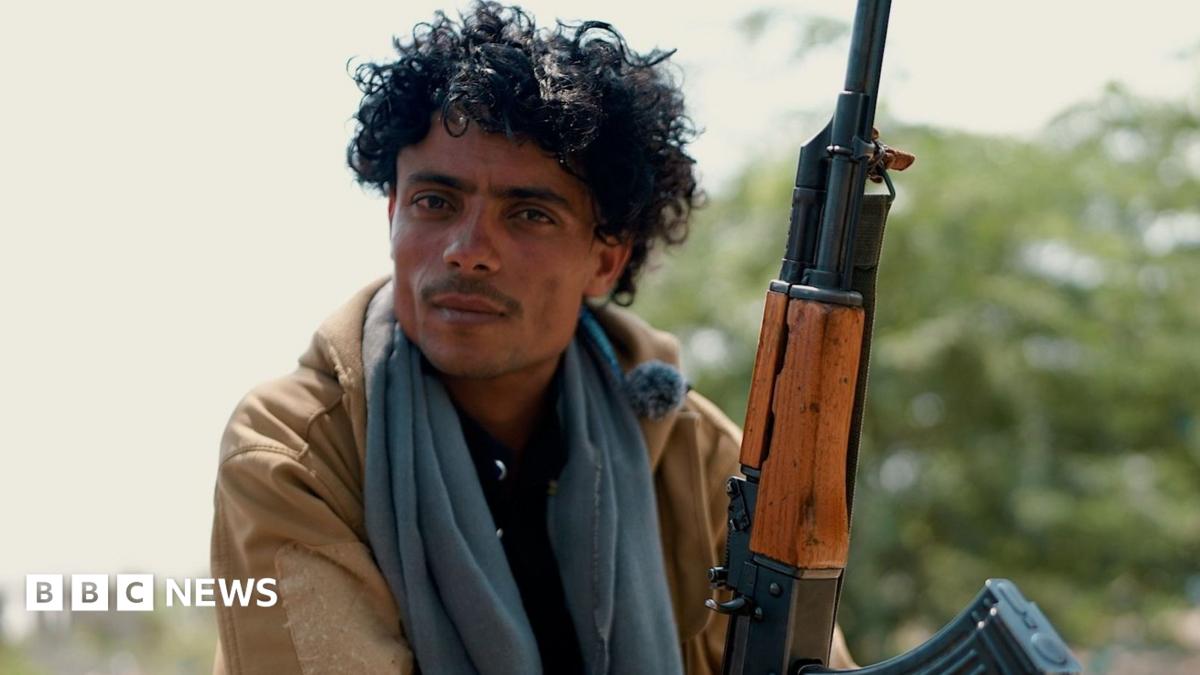
On a rugged hillside southwest of Taiz, the war in Yemen suddenly became immediate and personal. A government escort scanning the sky warned journalists travelling with him that an unmanned aircraft circling overhead was often a precursor to shelling or a ground assault. Moments later the group scrambled for shelter beneath scrub vegetation before retreating hastily to their vehicle and speeding away. Roughly ten minutes afterward, heavy detonations echoed across the valley, although their precise impact points could not be confirmed.
The episode illustrates how fluid and dangerous the perimeter around Yemen's third-largest urban centre has become. In the mountainous terrain outside Taiz, there is no clearly marked boundary between rival positions. Instead, control dissolves gradually into an exposed buffer zone, where patrols, observation drones and intermittent artillery fire signal the proximity of opposing fighters entrenched only a few hundred metres apart.
To reach that edge, the reporting team moved outward from the city alongside soldiers loyal to Yemen's internationally recognised authorities, passing a succession of manned posts until the road effectively ended. Beyond that last position lies open ground that neither side fully holds, a landscape of terraced slopes and scattered dwellings that offers little protection from surveillance in the air or fire from the heights.
That fragility follows a dramatic escalation earlier this month along the Red Sea coastline. Fighters from the Houthi movement, which dominates much of northern and western Yemen including the capital Sanaa, pushed southward in a coastal operation that shattered a truce which had largely restrained major offensives for around four years. Their capture of the port town of Mokha, roughly 85 kilometres west of Taiz on 10 September, has reordered the battlefield and revived fears of a wider return to full-scale civil conflict.
The implications extend well beyond the immediate front. By seizing stretches of shoreline and high ground overlooking the Bab al-Mandab Strait, the Houthis have positioned themselves near one of the world's most critical maritime chokepoints, the narrow passage connecting the Red Sea to the Gulf of Aden and linking trade routes between Europe and Asia. Analysts of energy and shipping markets note that even the prospect of disruption there can unsettle insurers and traders, and the latest fighting has already been associated with upward pressure on crude prices amid concerns about secure transit for oil and commercial cargo.
Maps compiled from open-source monitoring on 20 and 24 September, drawing on data from the Institute for the Study of War and the Critical Threats Project at the American Enterprise Institute, depict the scale of the shift. Broad areas shaded as Houthi-held stretch across western Yemen and extend south toward the strait, while hatched zones denote contested ground around those margins. A focused inset on the southwestern coast highlights the September gains, placing Taiz directly on the forward edge of the advance.
Around Taiz itself, the encirclement is tight. Soldiers aligned with the government retain the central districts, but Houthi units are established to the north and east, leaving the city hemmed in on multiple sides. Regional military observers say the most intense clashes in recent days have unfolded on the western approaches, where both sides are vying for elevated ridges that dominate the southern exit road. Control of those heights would shape any future attempt by government units to reverse the loss of Mokha and reopen supply lines.
The road into the embattled city underscores another challenge for the anti-Houthi camp: fragmentation. The journey north from Aden, the southern port city that serves as the seat of the Presidential Leadership Council and the internationally recognised administration, passes through about 30 separate checkpoints. Each is manned by fighters answering to different local commanders, a visible reminder that the government side is a coalition of disparate armed groups rather than a unified army, despite shared backing from Saudi Arabia.
As the convoy closed on Taiz, signs of intensifying combat multiplied. At least five ambulances were observed within a half-hour period racing toward the city's principal hospital, suggesting sustained casualties from shelling and small-arms engagements in the surrounding hills. For residents and medical staff, such traffic has become a grim barometer of the fighting's tempo.
Yet after nightfall, Taiz presented a jarring duality. Storefronts glowed, eateries were crowded, and children played in illuminated streets, projecting a semblance of normal urban life for a population estimated at nearly one million. That routine was punctuated at intervals by unmistakable reminders of the siege — dull concussions of artillery and sharp bursts of gunfire rolling down from the darkened mountains that ring the city.
Outside the urban core, the countryside tells a starker story of displacement. Villages dotted across the slopes stand largely empty, their owners having fled prolonged bombardment. The usual clamour of cars and motorbikes that fills Taiz is absent here, replaced by the bleating of unattended livestock and the alternating sounds of outgoing and incoming fire echoing between ridges.
About one kilometre from the forward positions, one resident who asked to be identified only as Ali remained among the few who stayed behind. Sitting outside his house beside his goats, he described how two mortar rounds had struck his land, damaging property and underscoring the daily risk. Like many hillside farmers, his home is both shelter and livelihood, making departure an agonising calculation rather than a simple choice.
Ali explained that he had already sent his children to a camp for displaced families because they could no longer endure the constant explosions and shooting. He himself stayed on with his wife and sisters to tend the animals on which the extended family depends. He spoke of dread, but said leaving the herd would condemn them to hunger, framing his decision as survival in the face of two lethal threats — violence and destitution.
That fear is compounded by uncertainty over who will ultimately control the area. The villager voiced apprehension about reprisals should Houthi forces overrun his district in the coming days. Such anxieties are reinforced by accounts from both camps that a larger confrontation is being prepared, with sources close to the Houthis describing a consolidation of reinforcements, while government officers insist they are aware of the build-up and are fortifying their own lines.
Near the final checkpoint, exhaustion and loss were evident among government troops rotating down from high-altitude outposts only a short distance from advancing opponents. One fighter recounted that the remains of 18 fallen comrades lay in a gully that his unit could cover with fire but could not safely enter to recover them. The account captures the grinding, positional nature of the battle, where even retrieval of the dead has become tactically impossible.
Taiz has long held outsized importance in Yemen's geography and identity. Widely regarded as the country's cultural capital, it occupies a pivotal junction between Houthi-dominated highlands to the north and government-aligned territories to the south. Its fate, humanitarian agencies and political analysts argue, will influence not only the humanitarian outlook for its large civilian population but also the trajectory of a conflict that once again threatens regional stability and international commerce.
What's Your Reaction?
 Like
0
 Dislike
0
 Love
0
 Funny
0
 Wow
0
 Sad
0
 Angry
0

Editor Investigasi. Pemenang penghargaan jurnalisme investigasi. Spesialisasi: korupsi, kolusi, dan maladministrasi.






Comments (0)