

Swiss Voters Backroom for Sanctions, Reject Locked-Down Neutrality
BERN — Swiss voters have delivered a decisive verdict against tightening the country's centuries-old tradition of diplomatic neutrality, backing the government's position that the
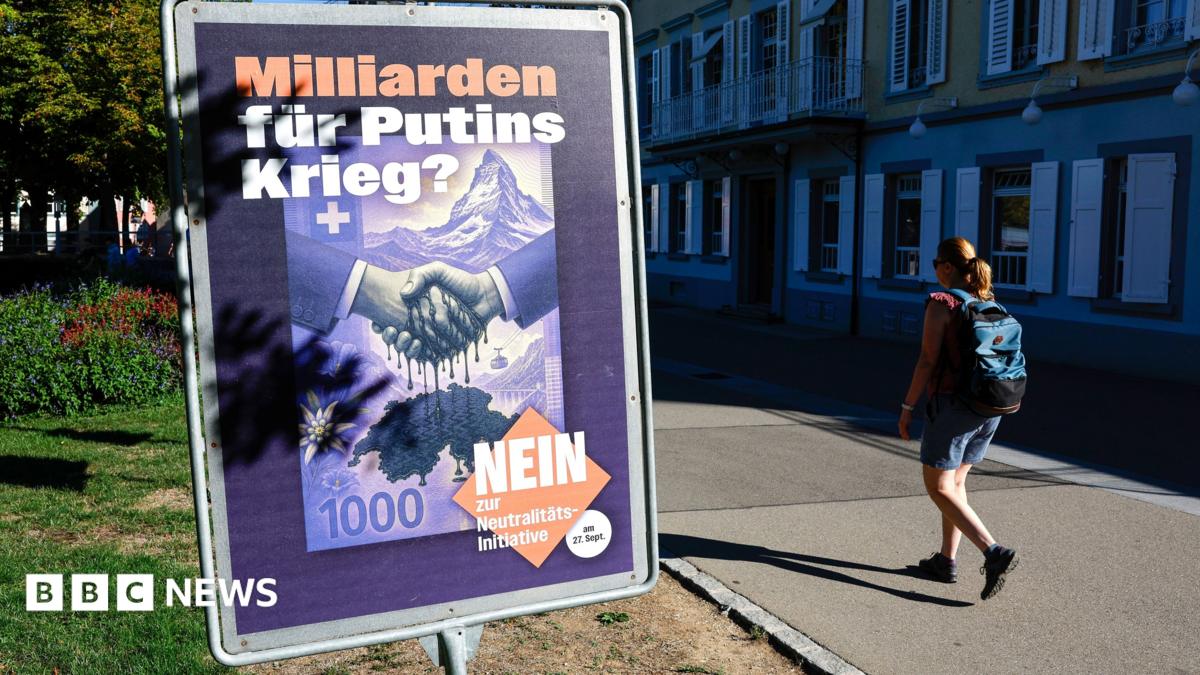
BERN — Swiss voters have delivered a decisive verdict against tightening the country's centuries-old tradition of diplomatic neutrality, backing the government's position that the Alpine state retains room to act independently on questions of war and peace. Official results showed more than 70% of those who cast a ballot rejected the package of measures that would have tied Switzerland's hands on sanctions and ruled out any move toward closer cooperation with the Nato military alliance.
The proposals, circulated under the banner of what campaigners and opponents branded the "Neutrality Initiative", were backed in the referendum by the right-wing Swiss People's Party, or SVP. They were opposed by the federal government and every other major party in the country. Moscow openly campaigned for the initiative, which supporters framed as a defence of Swiss independence and non-alignment at a moment of renewed European conflict.
Behind the vote lies Russia's full-scale invasion of Ukraine, which has sharply reopened a domestic debate about what neutrality means in an era of major-power war. The referendum asked whether a country whose neutrality was designed to keep it out of European conflicts should now be further insulated from the pressures of international sanctions, or whether neutrality should continue to be read as something adaptable rather than absolute.
Officials who backed the government's position argued that Swiss voters have not turned their backs on neutrality itself. Lukas Golder, co-director of the research institute Gfs.bern, told the Swiss public broadcaster SRF that the result did not represent a rejection of the country's embrace of its neutral status, but rather a demonstration that the public is in favour of sanctions against Russia. "People have a clear idea of what Switzerland's neutrality is supposed to achieve," he said.
Foreign Minister Ignazio Cassis made a similar case during a televised debate ahead of the vote, arguing that the concept has never been static. "Neutrality has always been applied with a degree of flexibility," he said. Switzerland, in his view, is not a spectator to events abroad, particularly when the rules of international order that underpin its own security are being openly violated.
The foreign minister also used the campaign to clarify the limits of the country's military-industrial policy. While Bern has no plans to lift the ban on selling arms to countries in conflict — a prohibition that applies to Ukraine as well — he stressed that "neutrality does not mean indifference". Switzerland, he added, would "not look away when we see violations of the very international rules that allow us to live in peace."
That flexibility has already been tested. Switzerland previously rejected a request from Germany for ammunition for tanks being sent to Kyiv, a decision that drew criticism at home and abroad but was defended as consistent with the legal framework governing Swiss supply of weapons material.
Switzerland's neutral status is not merely a modern policy choice. It was internationally recognised in 1815, when the country was granted "eternal neutrality" at the Congress of Vienna during a period of war and upheaval across Europe. The boundaries of that status were later laid out in legal terms by the Hague Convention of 1907, which forbade Switzerland from supplying weapons to countries at war — a rule that continues to underpin the arms embargo the government says it has no plans to lift.
The history of the doctrine is also a source of lasting criticism. Switzerland remained neutral throughout the Second World War. It banked gold looted by the Nazis, and in a move intended to deter an invasion by Nazi Germany, turned away thousands of Jewish refugees who sought entry to the country. Switzerland apologised for those policies in the 1990s, decades after the events themselves.
For a state of Switzerland's size, such questions are rarely settled by elected politicians alone. Its system of direct democracy means major political decisions are routinely deferred to the voters through referenda — a feature that placed this vote on the national ballot in the first place, and that will continue to shape future debates over Bern's foreign policy.
The campaign drew visible public mobilisation, with demonstrators in places such as Rheinfelden turning out with placards against the initiative, an image that captured the depth of feeling surrounding the question.
Analysts and the government will now have to consider what follows from the result. In practical terms, Switzerland retains the legal space to continue adopting measures aimed at Russia in coordination with its European partners, and to participate in political, financial or diplomatic initiatives that fall short of military alliance commitments. The vote also hands the foreign ministry a public mandate for that course, and a rebuke to the SVP, whose advocacy for a rigid reading of neutrality appears to have found limited traction among voters.
The deeper signal, according to Golder, is that the electorate distinguishes between neutrality as a tool for securing peace and neutrality as a barrier to responding to flagrant breaches of that peace. On that reading, the Swiss verdict is less a retreat from tradition than an affirmation of what the tradition was originally meant to accomplish.
What's Your Reaction?
 Like
0
 Dislike
0
 Love
0
 Funny
0
 Wow
0
 Sad
0
 Angry
0

Editor Investigasi. Pemenang penghargaan jurnalisme investigasi. Spesialisasi: korupsi, kolusi, dan maladministrasi.






Comments (0)