

Pope Leo XIV Draws Half a Million Faithful to Central Paris for Landmark Open-Air Mass
Hundreds of thousands of Catholic worshippers filled the heart of Paris on Saturday as Pope Leo XIV celebrated a giant open-air Mass along the French capital's most famous boulevar
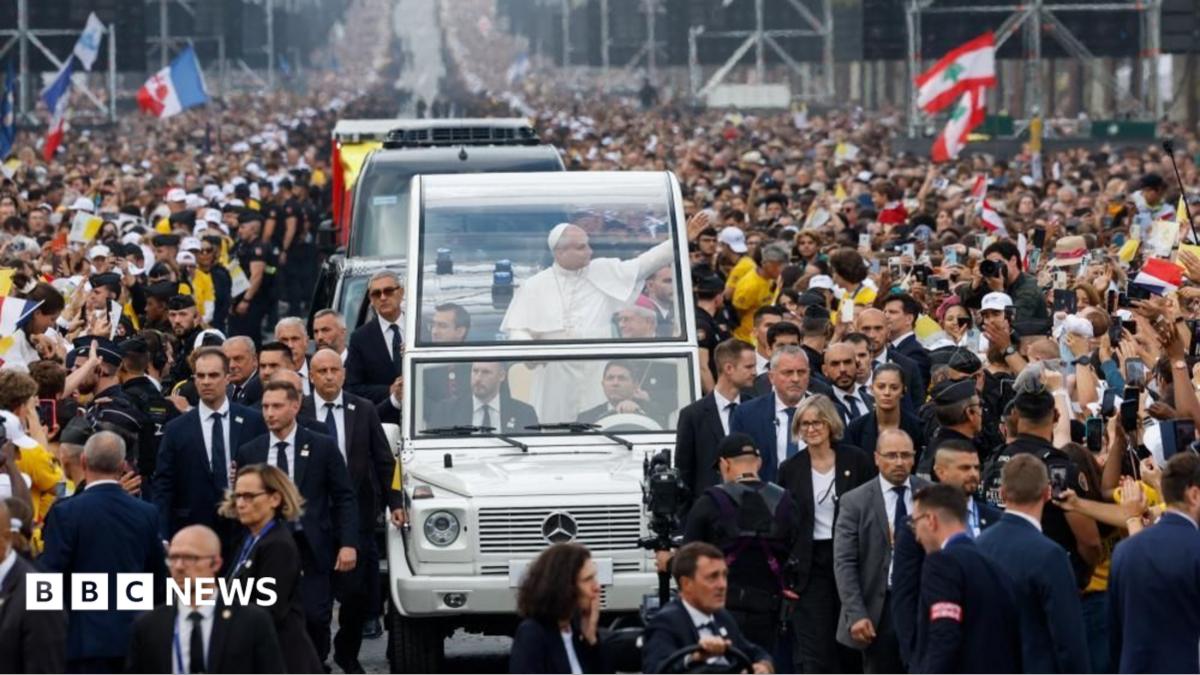
Hundreds of thousands of Catholic worshippers filled the heart of Paris on Saturday as Pope Leo XIV celebrated a giant open-air Mass along the French capital's most famous boulevard, in one of the largest religious gatherings the city has witnessed in recent memory.
The pontiff travelled down the Champs-Élysées beneath the Arc de Triomphe in his popemobile, waving to dense crowds that lined the avenue and cheered as he passed. Chants of "Leo, Leo" echoed through the streets as the head of the Catholic Church paused at various points along the route.
During those stops, the Pope blessed several babies held up to him by parents in the crowd, a gesture that appeared to delight onlookers pressed against the barriers. Many in the crowd clutched French flags and raised phones and cameras to capture the moment.
Organisers expect more than half a million people to take part in the event, for which a specially constructed altar has been erected on the Place de la Concorde, the vast square at the eastern end of the Champs-Élysées. The scale of the turnout reflects what Church officials describe as renewed spiritual interest among the French and other Europeans.
The Mass is the centrepiece of a four-day papal visit to France, and its location carries symbolic weight. The Champs-Élysées and the Place de la Concorde sit at the ceremonial heart of the republic, a setting that places the Church's most visible global figure at the centre of French national life.
French President Emmanuel Macron, who held an hour of talks with Leo on Friday, will not attend any of the Pope's Masses during the visit. The decision is widely understood as an effort to respect France's strict legal separation between church and state, a principle known as laïcité that has shaped French public life for more than a century.
In his place, First Lady Brigitte Macron and Prime Minister Sébastien Lecornu were present at the Champs-Élysées ceremony. Their attendance signals the government's desire to honour the visit without crossing constitutional boundaries.
The event also drew a striking cross-section of French political figures, underscoring the public significance of the papal visit less than a year before the country's next presidential election. Marine Le Pen of the hard-right National Rally and conservative Bruno Retailleau were both photographed at the Place de la Concorde ahead of the Mass.
Centrist contenders Édouard Philippe, the mayor of Le Havre and a former prime minister, and Gabriel Attal were also expected at the ceremony. Former Prime Minister François Fillon was seen in the square as well, according to reports from the scene.
Earlier on Saturday, before the main event, the Pope visited the Maison Bakhita centre, an association that supports refugees and migrants. There he met with migrants and praised the organisation for inviting people "to see those who are invisible."
Speaking during that visit, Leo said it was "possible to encounter one another and to live together in dignity and peace," comments that situate his message within broader European debates over migration and social inclusion.
He also emphasised what he called the fundamental role of women in building what he described as a civilisation of love, a theme he has returned to repeatedly in his public remarks.
The Pope's engagement with artificial intelligence has also been a defining feature of the trip. At the start of his visit on Friday, he issued a warning about the dangers of AI, cautioning against "losing our humanity amid a paradise of machines" during wide-ranging remarks delivered to Church and state officials at the Élysée Palace.
That intervention places the pontiff among a growing chorus of global leaders urging ethical guardrails around rapidly advancing AI technologies, while adding a distinctly moral and theological dimension to a debate often dominated by technical and economic concerns.
The visit continues on Sunday, when around 150,000 people have registered to attend a Mass at the sanctuary of Lourdes in the Pyrenees, one of Catholicism's most visited shrines and a site long associated with pilgrimage and healing.
On Monday, the Pope will travel to Metz in northeastern France, where he will pay tribute to Robert Schuman, a founding father of the European Union and a devout Catholic who is currently a candidate for beatification.
Leo's personal ties to France lend the trip additional resonance. Born in Chicago in 1955 as Robert Prevost, the pontiff carries a French name, and his paternal grandmother was born in Le Havre in Normandy in 1894. When she later married in the United States, she and her Italian husband adopted the surname Prevost, which had been her mother's maiden name.
That ancestry gives the Pope a familial connection to the very country he is now touring, a detail that has featured prominently in French coverage of the visit and may help explain the warmth of the reception he has received.
For the Vatican, the scenes in Paris and the expected crowds in Lourdes offer evidence that religious practice and affiliation are not fading uniformly across Europe, despite decades of declining Mass attendance and church membership in many Western nations.
Whether that enthusiasm translates into a durable revival remains an open question, but for a single September weekend at least, the streets of Paris belonged to a Church celebrating one of its most visible moments on French soil in years.
What's Your Reaction?
 Like
0
 Dislike
0
 Love
0
 Funny
0
 Wow
0
 Sad
0
 Angry
0

Editor Investigasi. Pemenang penghargaan jurnalisme investigasi. Spesialisasi: korupsi, kolusi, dan maladministrasi.






Comments (0)