

Photographs Reveal Severe Damage to US Military Bases Across Middle East from Iranian Strikes
Newly surfaced photographs provided by active-duty American military personnel have revealed significant and widespread destruction across United States military installations in t
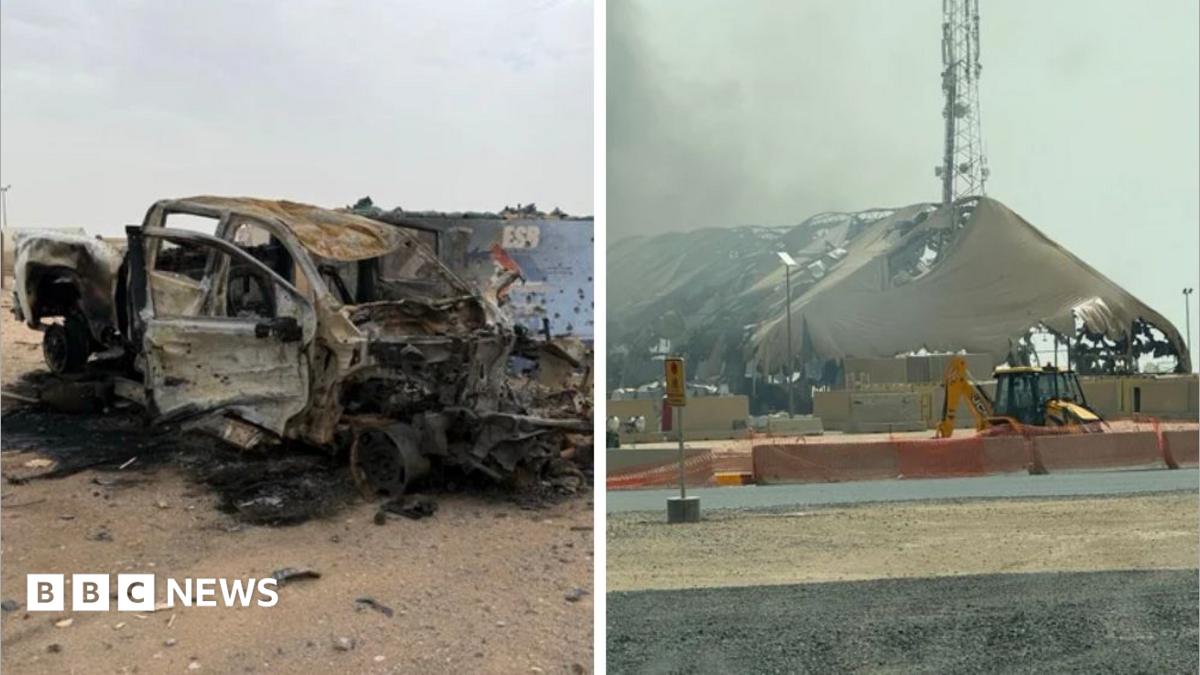
Newly surfaced photographs provided by active-duty American military personnel have revealed significant and widespread destruction across United States military installations in the Middle East following targeted Iranian strikes. The visual evidence, obtained by the BBC's American partner CBS News, depicts heavily damaged military infrastructure, flattened temporary housing units, and ruined aircraft across facilities located in Saudi Arabia and Kuwait.
The undated images offer an unvarnished look at the physical toll sustained by American forces deployed in the region. Among the wreckage documented are flattened trailers, shredded tent-like installations, burnt-out vehicles, and structural damage to multi-story buildings, alongside the catastrophic destruction of advanced military aviation assets.
The visual revelations have triggered sharp criticism from within the ranks regarding official transparency. An active-duty service member who spoke to CBS on the condition of anonymity expressed frustration over the perception that the scope of the devastation was being obscured, remarking that significant base destruction had not been adequately shared with the American public and describing personnel as standing by helplessly while taking direct hits.
In response to queries regarding the photographic evidence, the White House referred journalists to United States Central Command, which did not immediately provide a formal statement. The photographs have not been independently authenticated by the BBC, though key elements align with previously documented incidents during the ongoing regional conflict.
One of the most consequential images depicts a Boeing E-3 Sentry stationed at Prince Sultan Air Force Base in Saudi Arabia, situated roughly 62 miles (100 kilometers) southeast of Riyadh. The surveillance aircraft is shown ripped in half, with its tail section crumpled into a mangled heap of metal. The E-3 platform, commonly known as an AWACS aircraft, plays a vital strategic role in early threat detection by utilizing long-range radar systems to track incoming aerial targets.
While the specific date of the newly released image remains unconfirmed, BBC Verify previously validated a similar photograph showing the same damaged radar aircraft in March. Around the time of that strike, a United States official confirmed to Reuters that twelve American service personnel were injured at the Saudi air base, with two sustaining serious wounds.
Additional photographic evidence highlights heavy destruction at Camp Buehring in Kuwait, where multiple trailers were reduced to crumpled debris and a large tent-like shelter was completely shredded as plumes of smoke drifted over the compound. A destroyed car was also among the wreckage photographed at the site.
Further imagery captured severe damage to a four-storey building situated at Camp Arifjan, another major American operational installation in Kuwait. Camp Arifjan had previously sustained reported damage to its satellite communications hardware during strikes in March, although it remains unclear whether the newly published photograph documents that exact incident or a subsequent attack.
The release of these photographs follows immediately on the heels of an official report from the Pentagon's inspector general. The watchdog's findings confirmed that Iranian strikes have damaged and destroyed hundreds of structures and buildings across American military bases throughout eight Middle Eastern countries during the conflict: Kuwait, Bahrain, Qatar, the United Arab Emirates, Saudi Arabia, Iraq, Oman, and Jordan.
According to the watchdog's formal audit, the broader conflict has generated staggering financial and material costs for the United States. Equipment losses across the regional theater have accumulated to $3.7 billion (£2.8 billion), while overall American defense spending tied directly to the war reached $33.4 billion (£24.7 billion) through June 29.
The inspector general's assessment detailed extensive aviation casualties, noting that dozens of American aircraft were damaged or destroyed in the months following the initial outbreak of hostilities. Among the documented losses were five specialized aerial refueling tankers, all of which were hit and disabled or ruined on the ground in Saudi Arabia by Iranian munitions.
Further details regarding the material impact were detailed in a separate assessment published by the Congressional Budget Office (CBO). The agency highlighted that because the Boeing E-3 Sentry is no longer in active production, damaged airframes cannot simply be rebuilt and must instead be replaced with the more modern E-7 platform at an estimated replacement cost of $500 million (£371 million) per aircraft.
The CBO calculated total battlefield equipment losses at approximately $1.9 billion (£1.4 billion), a figure that accounts for destroyed fixed-wing aircraft, unmanned aerial drones, and a Terminal High Altitude Area Defense (THAAD) missile system. However, the budget office acknowledged that its analysis was subject to uncertainty because the Department of Defense declined to respond to formal requests for information, compelling the agency to rely on public reporting and open government databases while leaving future reconstruction plans undefined.
These mounting material losses and infrastructure strikes have intensified political and public scrutiny on the White House to negotiate an end to the hostilities. The conflict initially erupted on February 28 when American and Israeli forces carried out coordinated joint strikes on Iran, provoking continuous Iranian retaliatory barrages against American military outposts, regional Gulf partners, and Israel, while raising growing domestic concerns over operational readiness and munitions shortages.
What's Your Reaction?
 Like
0
 Dislike
0
 Love
0
 Funny
0
 Wow
0
 Sad
0
 Angry
0

Editor Investigasi. Pemenang penghargaan jurnalisme investigasi. Spesialisasi: korupsi, kolusi, dan maladministrasi.






Comments (0)