 ramadiansyah
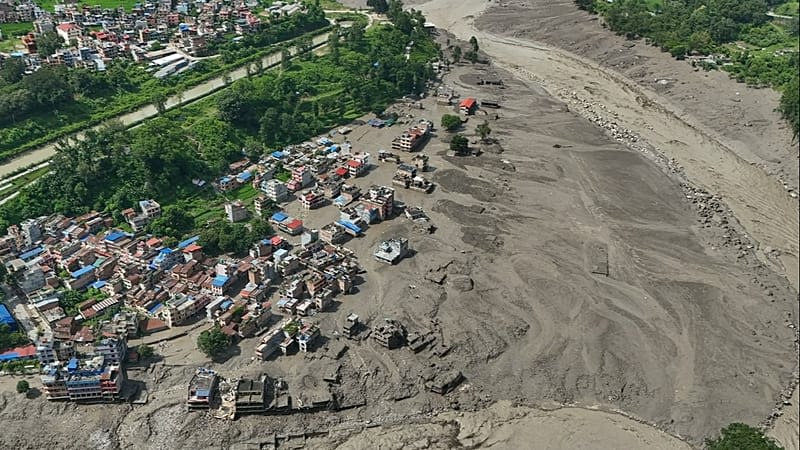
A devastating flash flood that surged through a Himalayan district on Nepal's frontier with China has claimed at least 19 lives, while close to 400 travellers remain unreachable, according to officials in Kathmandu.
The Nepal Tourism Board said Wednesday that records compiled from tourism operators and travel agencies showed 384 people had been reported missing in the affected zones — 291 of them foreign visitors and 93 Nepali citizens. Authorities stressed the figures were preliminary and that teams were still working to establish where the travellers are.
Nepali police spokesperson Abi Narayan Kafle confirmed that nineteen bodies had been retrieved so far. He said rescue and relief operations were being coordinated around the clock, adding that a number of police officers deployed to the area had themselves lost contact with headquarters.
Dramatic footage circulated by police and witnesses on social media captured walls of sediment-heavy water tearing through mountain valleys in the district straddling the Chinese border. In Nuwakot district, teacher Suman Chalise described watching the torrent engulf vehicles and buildings in seconds. The 34-year-old told AFP he saw eight or nine trucks swept away alongside homes and people, calling the destruction heartbreaking and unlike anything he had ever seen.
Images released by news agencies showed wrecked houses and battered vehicles strewn along the banks of the Trishuli River, one of the waterways hit hardest by the deluge. Kafle said earlier that the full scale of the damage was not yet known, but noted that residents living close to riverbanks had been warned to move to safer ground.
The Nepal Army announced it had rushed helicopters and specialist disaster response teams into the stricken area to assist with search and evacuation efforts.
Critical infrastructure also took a severe blow. The state-run Nepal Electricity Authority estimated that roughly 430 megawatts of generating capacity — spanning both hydropower plants and solar installations — had been damaged. The authority said the disaster wrecked its production, transmission and distribution networks, cutting power supplies to affected communities.
Scientists are beginning to piece together what triggered the catastrophe. Sarthak Shrestha, a remote sensing and geo-information analyst at ICIMOD, a research centre based in Kathmandu, said early satellite assessments found nothing unusual on the Chinese side of the border. Evidence instead points to a rock-ice avalanche inside Nepal that dammed the Lhende river and unleashed a cascading flood downstream.
Several major highways have been shut because of the flooding, compounding the logistical challenge facing rescuers. Across the border, Chinese state broadcaster CCTV said a mudslide on the Nepalese slope caused heavy casualties and numerous missing persons at the Gyirong Port crossing in Tibet, airing clips of churning water hauling branches and debris over inundated roads.
Chinese President Xi Jinping has called for an all-out rescue mobilisation, according to CCTV. He was quoted saying the most pressing priority is locating the missing, delivering rapid treatment to the injured and keeping the death toll as low as possible.
Traffic officials in Tibet's Shigatse region warned Wednesday via social media that local roads remained under threat from further mudslides and were impassable. The same crossing was the scene of tragedy just over a year ago, when 17 people disappeared in a mudslide near Gyirong Port last July.
Monsoon downpours between June and September routinely unleash deadly floods and landslides across South Asia, and experts warn that fragile Himalayan slopes — destabilised by glacial melt and steep terrain — make the region especially vulnerable to disasters of this kind.





Comments (0)