

India Opposition Lawmakers Detained During Delhi March Demanding Election Chief's Resignation
Police in India's capital detained a group of opposition parliamentarians on Tuesday as they attempted to march on the Election Commission headquarters, the latest flashpoint in an
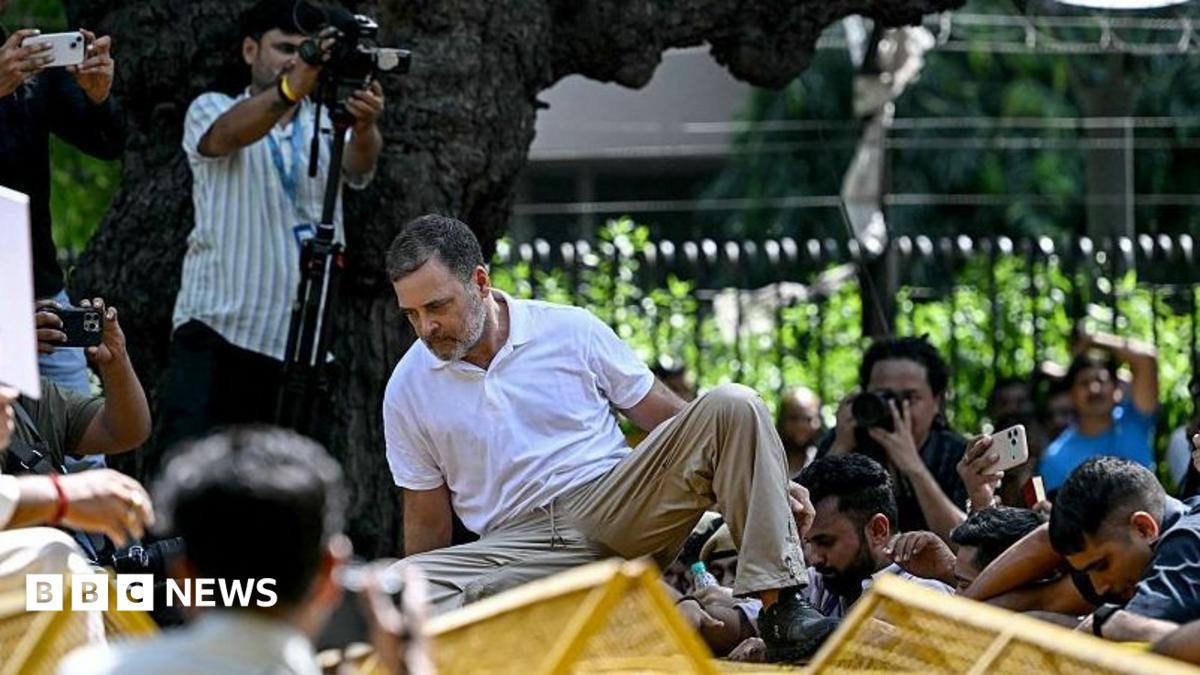
Police in India's capital detained a group of opposition parliamentarians on Tuesday as they attempted to march on the Election Commission headquarters, the latest flashpoint in an intensifying dispute over the country's voter roll revision process. Among those briefly taken into custody was Rahul Gandhi, the leader of the opposition in the lower house of parliament, along with his sister Priyanka Gandhi and a number of other lawmakers from across the opposition spectrum.
The confrontation unfolded as the politicians tried to push past barricades blocking the route between parliament and the commission's offices in central Delhi. Security forces had sealed off the roads well before the march began, with personnel from the Central Reserve Police Force and the Rapid Action Force deployed in strength around the area. Many of the lawmakers, including Gandhi, were stopped midway through their advance toward the commission building.
According to Additional Deputy Commissioner of Police Manjeet Sheoran, officers were positioned at multiple points along the route and intercepted the protesters as they attempted to use alternative roads to reach the Election Commission premises. Those picked up were placed in police buses and transported to different police stations, he told the BBC. Authorities did not release a figure for how many lawmakers had been detained, while opposition organizers claimed that 237 MPs from a range of parties took part in the demonstration.
The detentions were short-lived. Those held were released shortly afterward, and they regrouped to resume their march before staging a sit-in near the Election Commission headquarters. The protest marks a significant escalation in a political standoff that has been building for months over the conduct of the Special Intensive Revision, known as the SIR, of India's electoral rolls.
At the heart of the dispute is the revision exercise, which began in the eastern state of Bihar in June 2025 and has since been extended to other regions of the country. The Election Commission maintains that the purpose of the process is to eliminate duplicate and ineligible entries from the voter lists, describing it as a routine cleanup of the electoral database. More than 130 million names have been removed from draft voter lists nationwide so far, according to figures cited in the controversy.
Opposition parties and civil society activists strongly contest that characterization. They argue that large numbers of legitimate voters have been wrongly struck from the rolls and accuse the poll body of carrying out the exercise in a flawed and opaque manner. The scale of the deletions, they contend, raises serious questions about how many citizens could be disenfranchised ahead of future elections.
The campaign against Chief Election Commissioner Gyanesh Kumar has gained substantial momentum in recent weeks following an investigation published by the Indian Express newspaper. That report said two election commissioners, Sukhbir Singh Sandhu and Vivek Joshi, had formally lodged objections at least 14 times over a ten-month period regarding decisions and orders they said had been issued in the commission's name without their knowledge.
The objections reportedly covered a range of sensitive matters, including additions to and deletions from voter rolls, access to the voter database and the security of electoral data. Some of the concerns were directly connected to the electoral roll revision programme at the center of the current controversy, lending further weight to opposition claims that the process has been mismanaged.
The Election Commission, which operates as a three-member body consisting of the chief election commissioner and two election commissioners, has defended its internal decision-making. It has stated that differences of opinion are a normal part of institutional functioning and that its decisions were ultimately taken unanimously. That explanation has not quieted critics, and the revelations have triggered a sharp political backlash, with opposition leaders redoubling their calls for Kumar to step down.
Opposition parties allege that the revision process could ultimately benefit Prime Minister Narendra Modi's Bharatiya Janata Party, an accusation that both the BJP and the Election Commission have firmly rejected. The governing party has pushed back hard against the protests, with BJP MP Sambit Patra describing them as a "sponsored attempt" to bring about a change of power through what he characterized as anarchy. He also accused opposition parties of trying to undermine constitutional institutions, including the Election Commission.
Congress president Mallikarjun Kharge outlined three demands he described as non-negotiable: Kumar's resignation, the cancellation of the SIR exercise and a return to paper ballot voting. Rahul Gandhi, meanwhile, mocked the election chief in a social media post, writing that it was time for Kumar to resign.
Tuesday's march came just four days after the Cockroach Janta Party, an online satirical movement backed by Gen Z, organized demonstrations in Mumbai and Delhi that also called for the chief election commissioner's resignation. That group has framed its earlier protests as the opening phase of a nationwide campaign and has announced plans for another round of demonstrations on 10 October.
The controversy has also reached India's Supreme Court, which has asked both the federal government and the Election Commission to respond to a petition alleging that Kumar took key decisions without the approval of the two other election commissioners. The petition argues that he exercised powers that properly belong to the commission collectively and seeks a ruling that any such actions were unauthorized.
The court indicated that Election Commission decisions must be taken either unanimously or by majority vote, and suggested that decisions could be set aside if they were found to have bypassed that procedure. The proceedings add a judicial dimension to a dispute that now spans street protests, parliamentary maneuvering and constitutional argument, with the outcome likely to shape how India's electoral machinery is governed in the run-up to future national contests.
What's Your Reaction?
 Like
0
 Dislike
0
 Love
0
 Funny
0
 Wow
0
 Sad
0
 Angry
0

Fact-Check Editor. Verifikator bersertifikasi IFCN. Memeriksa klaim viral dan disinformasi.






Comments (0)